

Table of Contents
- Dog Separation Anxiety Symptoms: What You're Actually Seeing
- A Separation Anxiety Training Plan for Dogs, Step by Step
- How Long Does Dog Separation Anxiety Training Take?
- Calming Aids for Dogs with Separation Anxiety
- Calm Departures, Calm Reunions, and a Routine That Holds
- Exercise, Enrichment, and a Safe Space Before You Leave
- Monitoring Progress and Handling Unavoidable Absences
- When to Call Your Vet: Assessment and Referral Pathways
- Frequently Asked Questions
Last Updated: October 18, 2026
Dog Separation Anxiety Symptoms: What You're Actually Seeing
Dog separation anxiety is a panic response triggered by the owner's absence, not a discipline problem or spite. Owners come home to chewed doorframes assuming their dog is angry, when the behavior is closer to a panic attack.
Timing tells you a lot. Separation-related behavior usually starts within minutes of departure; a dog that destroys a cushion four hours into an eight-hour absence is showing something different.
When It's Not Separation Anxiety: Boredom, Confinement Distress, or Noise Sensitivity
Boredom looks similar but is treated completely differently: a bored dog chews whatever is available at any point in the day and settles fine once tired. Confinement distress is panic about the crate or closed room, even when you are home. Noise sensitivity flares during thunderstorms or fireworks, not when you leave. Video is the cheapest diagnostic tool: record two absences and note when behavior begins.
A Separation Anxiety Training Plan for Dogs, Step by Step
A separation anxiety training plan for dogs works by teaching the dog that departures are boring and returns are unremarkable, using gradual desensitization and counterconditioning rather than forced exposure. The core rule: never leave the dog alone longer than it can currently handle without panic, because every session that tips it over its threshold sets the plan back.
Here is the sequence we recommend.
- Establish a baseline. Record one normal absence and time how long your dog stays relaxed. That number, often seconds or a few minutes, is your starting point. If the dog is already stressed at the door, your baseline is zero and you start with cue desensitization only.
- Practice fake departures. Pick up keys, put on shoes, open the door, sit back down. Repeat until these departure cues stop triggering a stress response. This step is about the cues, not the absence.
- Add duration in small steps. Leave for the baseline duration, return before panic starts, and repeat until the dog is relaxed at that length. A calm rep means settled, not just quiet.
- Extend by short increments. Add a minute or two at a time, and only move forward after three calm repetitions. If a rep tips into stress, end on a calm note at a shorter duration and try again next session.
- Vary the pattern. Once you reach fifteen to twenty minutes, start varying absence lengths so the dog stops predicting a fixed return time.
Finding Your Dog's Threshold
The threshold is the longest absence your dog can handle while staying relaxed, and it is almost always shorter than owners expect. Start with an absence you are confident the dog can handle (often 10 to 30 seconds), then add time until the first stress signal: lip licking, yawning, pacing, staring at the door, or a change in breathing.
The threshold is not a single number: it can be shorter in the morning, longer after exercise, and shorter when routines are disrupted. Track conditions alongside duration to see which variables matter.
Graduated Absence Protocol: Timing and Progression Criteria
Use this table as your working protocol. It is the part most guides skip.
| Stage | Absence Duration | Progression Criterion | Typical Sessions |
|---|---|---|---|
| 1. Cue desensitization | 0 minutes (door open) | No stress signals at keys or shoes | 5-10 short reps daily |
| 2. Baseline absence | 10 seconds to 2 minutes | Dog stays settled, no vocalization | 3-5 reps per session |
| 3. Short extension | 5 to 15 minutes | Three calm reps at current length | 2 sessions daily |
| 4. Mid-range | 20 to 45 minutes | No pacing or destruction on video | 2 sessions daily |
| 5. Real-world | 1 to 4 hours | Calm departure and calm return | 3-4 sessions weekly |
How to read the table. Each row is a gate, not a schedule.
Session structure. Keep sessions to five to fifteen minutes of repetitions, ending on a calm rep.
Handling plateaus. If three consecutive sessions at the same duration fail, the duration is too high. Drop back to the last duration that produced three calm reps and rebuild.
How Long Does Dog Separation Anxiety Training Take?
Most dogs need weeks to months of consistent daily practice, not days. How long dog separation anxiety training takes depends on severity, how long the behavior has been rehearsed, and how many calm repetitions you fit into a week.
Progress is not linear: a dog that handles forty minutes on Tuesday may panic at twenty on Thursday after a disrupted routine. Log each session's duration and outcome, and judge progress by the trend line, not any single day.
Calming Aids for Dogs with Separation Anxiety
Calming aids for dogs with separation anxiety support a training plan; they do not replace one.
Our Chill Dood Soft Chew combines L-Theanine, Ashwagandha, Magnesium Citrate, Valerian Root, and Chamomile to support relaxation and balanced behavior without drowsiness. It is made with human-grade ingredients and no fillers, and it is designed to take the edge off rather than sedate your dog.

Calm Departures, Calm Reunions, and a Routine That Holds
Calm departures and calm reunions are a skill you practice, not a personality trait. The goal is to make your exit and return so uneventful that neither carries emotional weight. Most owners accidentally build the opposite: a long goodbye and an excited welcome home, which teaches the dog that absences are a big deal.
A routine that holds looks like this:
- Keep goodbyes to a neutral phrase and walk out without lingering
- Leave a predictable setup: bed, water, enrichment item, background sound
- Return quietly, wait for the dog to settle, then offer calm attention
Consistency matters more than any single tactic: a dog that can predict the shape of the day relaxes faster.
Exercise, Enrichment, and a Safe Space Before You Leave
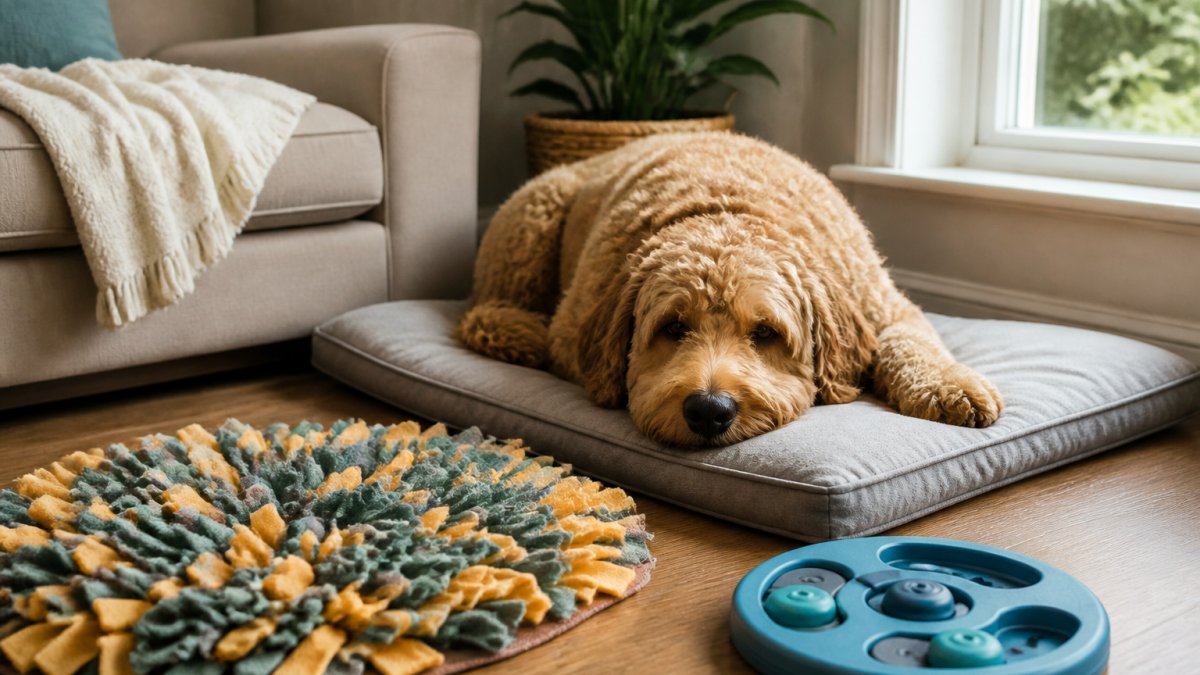
Physical exercise and mental enrichment lower the baseline anxiety your dog brings to an empty house.
Enrichment continues after you go: puzzle toys, scatter feeding, snuffle mats, and frozen food toys give the dog a job during the first twenty minutes of absence, usually the hardest stretch.
Monitoring Progress and Handling Unavoidable Absences
Monitoring progress turns a vague hope into a measurable plan. Most owners judge progress by whether the house is still intact, which tells you almost nothing about whether the dog is calmer. Instead, record absences and track a small set of numbers.
What to Measure on Video
Set up a camera that covers the exit door and the dog's main resting area, and record every training absence. Review the first ten minutes, which is when most separation-related behavior appears, and log four things:
- Latency to distress: how many seconds or minutes pass between your exit and the first stress signal (lip licking, pacing, vocalizing, staring at the door). This is the single most useful number, because it usually grows before the destruction stops.
- Duration of vocalizing: total seconds of barking, whining, or howling. A dog that vocalizes for two minutes instead of twenty is improving even if it is not yet silent.
- Destructive or escape behavior: whether it happened, and at what point in the absence.
Log these alongside absence duration and conditions (time of day, exercise before, who was home). After two weeks you will have a trend line that tells you whether to advance, hold, or drop back a stage. Bring the log and a few short clips to any trainer or vet appointment.
Handling Unavoidable Absences
Unavoidable absences happen, and the goal is damage control, not perfection. Training only works if the dog is not left alone beyond its threshold for long stretches, so arrange coverage for absences you cannot shorten.
- Book a sitter or daycare for long days. A familiar pet sitter, a daycare, or a trusted neighbor beats a long solo stretch every time. Line this up before you need it, not the morning of.
- Use a familiar sitter or friend's house rather than a new environment. Novel places can be stressful on their own.
- Keep the departure routine identical even when someone else is watching the dog. The cues should stay boring regardless of who is home.
When to Call Your Vet: Assessment and Referral Pathways
Call your vet when the behavior is severe, when your dog injures itself, or when weeks of consistent training produce no improvement.
Referral pathways usually run from your general vet to a veterinary behaviorist, who can assess medication options alongside a training plan. Medication is not a failure; for some dogs it lowers anxiety enough that training can finally take hold.
Separation anxiety is manageable, but it asks for patience and a plan you can measure week by week. NutraDoodle™ makes calming support simple with human-grade, filler-free formulas like our Chill Dood Soft Chew, made in the USA with L-Theanine, Ashwagandha, and Chamomile to help your dog settle without drowsiness.
Frequently Asked Questions
What are the signs of separation anxiety in dogs?
The most common signs are vocalization (barking, whining, or howling) that starts within minutes of your exit, destructive chewing or scratching focused on doors and windows, house soiling in a dog who is otherwise house-trained, and escape attempts. Many dogs also pace, drool, or pant heavily. The tell is timing: dog separation anxiety symptoms show up almost immediately after you leave and stop once you return, which separates them from general boredom or mischief.
How long does it take to help a dog with separation anxiety?
It depends on severity, but most behavior professionals describe weeks to months of consistent work, not days. A dog comfortable at 5 minutes might reach 30 minutes in a few weeks, while a dog with panic-level responses can take several months of graduated absences. Progress is measured in seconds and minutes added, not leaps. If you skip steps or push too fast, setbacks add time, so slow and steady genuinely wins here. A behavior veterinarian can shorten the timeline by addressing the panic directly.
Should I leave my dog alone if they have separation anxiety?
Not at full duration while you're training. Every panic episode rehearses the fear and can undo weeks of work, so during the training period arrange daycare, a sitter, or dog-friendly errands to keep absences under your dog's current threshold. That doesn't mean never leaving them alone; it means leaving only at durations they can handle calmly, then building up. Once your dog is reliably calm at real-life durations, normal absences resume.
Why is my dog destructive when left alone?
Destruction is often a symptom, not the problem. Chewed door frames, scratched windows, and shredded blinds usually point to escape attempts driven by panic, while torn cushions and scattered trash more often signal boredom or under-stimulation. Check the pattern: damage concentrated at exits plus drool and barking suggests separation-related behavior, while scattered, playful mess points to enrichment gaps. Video of one absence tells you which you're dealing with and which plan to follow.
Are calming aids for dogs with separation anxiety safe?
Calming aids range from pheromone diffusers and calming chews to vet-prescribed medication, and safety depends on the product and your dog. Look for clearly labeled ingredients, avoid anything marketed as a sedative that just knocks your dog out, and check with your vet before combining supplements with medication. NutraDoodle's Chill Dood Soft Chews, for example, use L-Theanine, ashwagandha, magnesium citrate, valerian root, and chamomile, and are formulated for calm without drowsiness. Calming aids work best alongside training, not instead of it.
When should I talk to a veterinarian about my dog's separation anxiety?
Talk to your vet if your dog injures themselves during absences, if you can't leave for even a few minutes without panic, or if weeks of training show no progress. A veterinarian can rule out medical causes, assess severity, and refer you to a board-certified veterinary behaviorist. Medication isn't a failure; for moderate to severe cases it lowers the panic enough that training can actually take hold. Bring video of an absence to the appointment, since it makes assessment far more accurate.